Range & performance
Electric propulsion for sailing yachts
The JOOOL electric drive pod is a direct-drive propulsion system for sailing vessels from 40 to 65 feet, monohull and multihull. Available as factory-integrated propulsion on new builds and as a retrofit solution for existing vessels.
What is electric propulsion on a sailing yacht?
Electric propulsion replaces or supplements a diesel engine with electric motors that drive the propeller directly. On a sailing yacht, this means silent, instant-torque drive for harbour manoeuvring, coastal motoring, and light-wind passages, without the noise, vibration, and exhaust of a diesel engine. An electric motor has no gearbox, no cooling circuit, no fuel injection system, and no exhaust. It is mechanically simple, exceptionally efficient, and in the case of JOOOL's Electric Pod, certified for more than 100,000 hours of continuous operation with minimal maintenance. Electric propulsion on a sailing yacht is almost always part of a hybrid-electric system: the electric motor handles propulsion, a battery bank stores energy, and a generator or renewable sources (solar, hydrogeneration) keep the batteries charged on longer passages. The JOOOL OneBox Propulsion system integrates all these elements into a single, pre-engineered platform.
Technology
Direct drive: the technology behind silent propulsion
Traditional diesel propulsion uses an engine, a gearbox, and a shaft to turn the propeller. Each mechanical interface introduces losses, noise, and maintenance requirements. The gearbox alone adds weight, complexity, and a regular service interval. Direct-drive electric propulsion eliminates the gearbox entirely. The JOOOL Pod connects its electric motor shaft directly to the propeller shaft, one moving assembly, zero mechanical intermediaries. The result is a system that is quieter, lighter, more efficient, and dramatically simpler to maintain than any diesel equivalent.
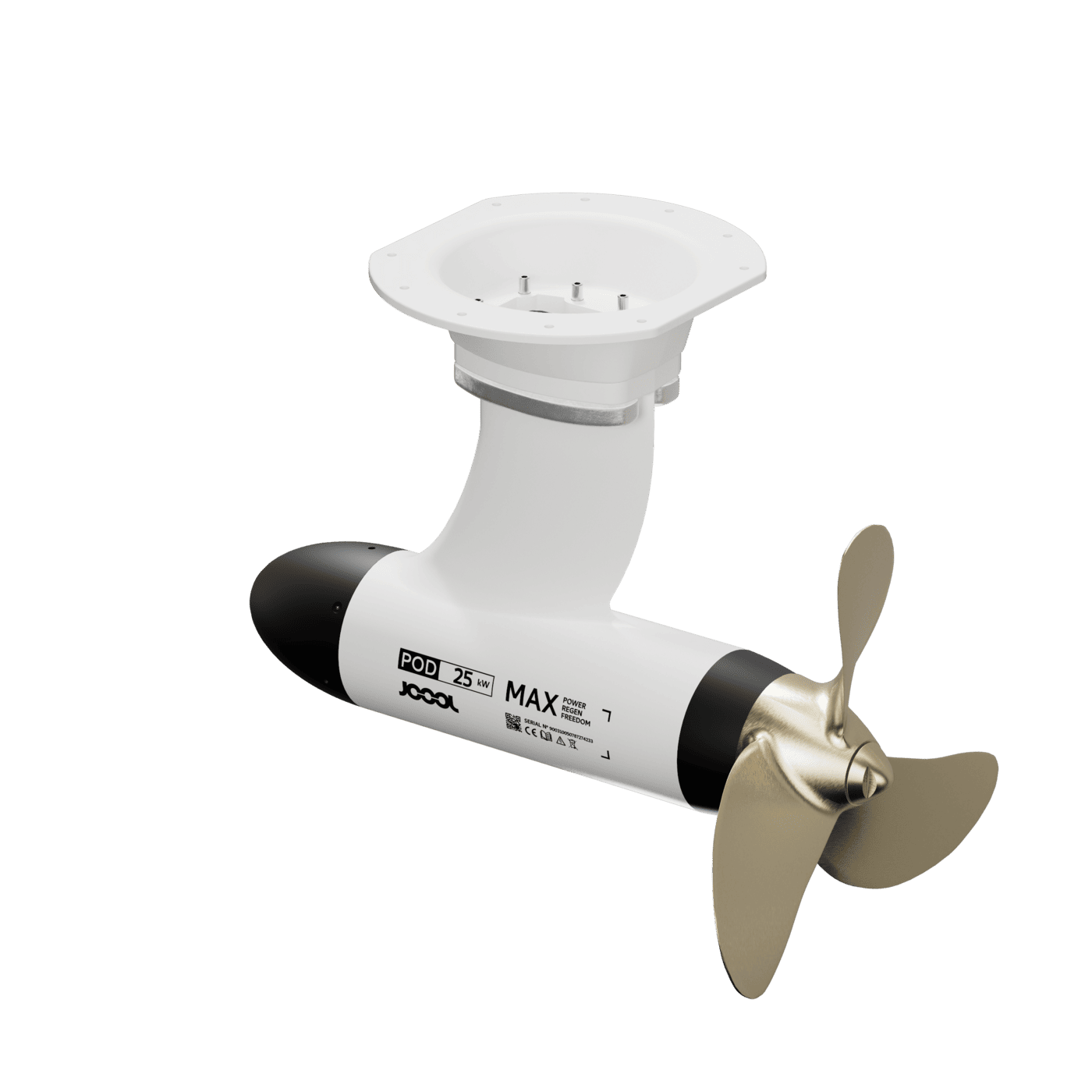
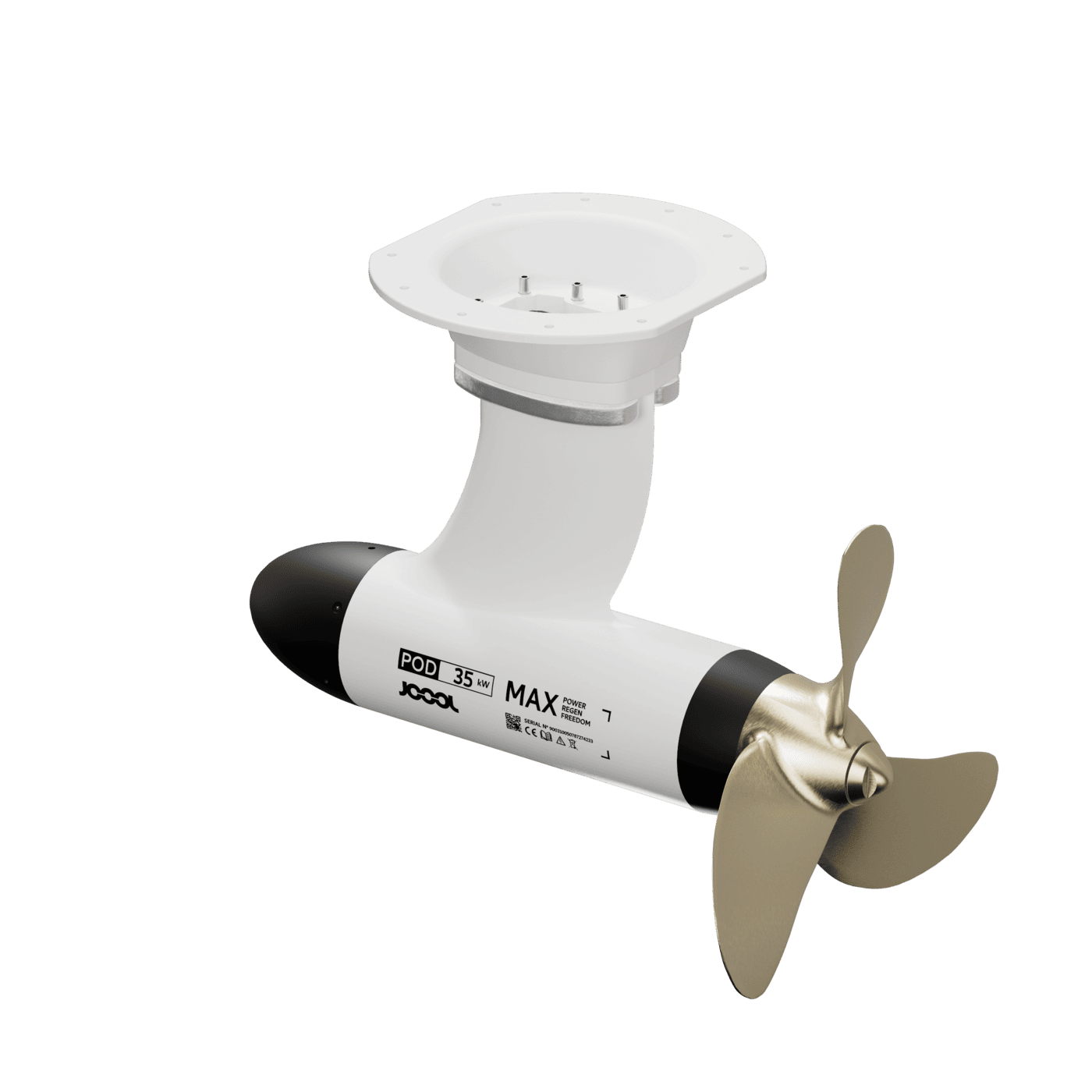
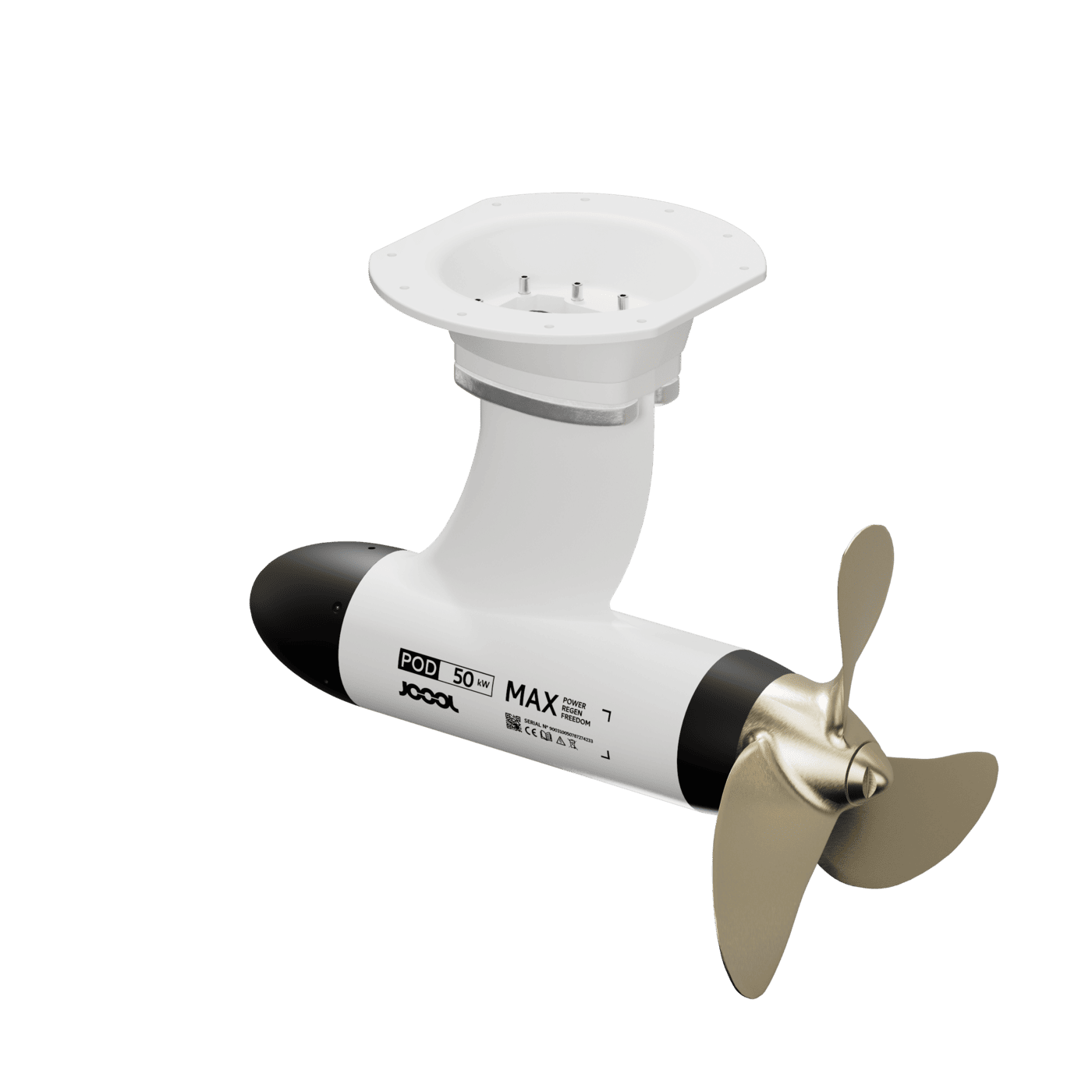
A submersible, below-hull motor unit that integrates directly into the vessel's keel area or stern. The permanent magnet synchronous motor operates at 1,100 RPM nominal, matched to a 22–26 inch propeller, with motor efficiency exceeding 93%.
Power flows from the battery bank through the OneBox Propulsion, which manages voltage conversion and current delivery. From zero to full thrust in under a second.
The electric drive pod uses surrounding seawater for cooling, the motor casing transfers heat directly to the water through which it moves. No freshwater cooling circuit, no heat exchanger, no impeller, no coolant reservoir. One fewer system to install, one fewer system to maintain, one fewer system to fail at sea.
The JOOOL electric drive pod is rated IP69 fully protected against sustained immersion and high-pressure water jets.
When sailing with the propeller freewheeling, the electric drive pod automatically switches to generator mode, the propeller's rotation feeds electrical current back into the battery bank via the OneBox.
At 7 knots, a single pod recovers approximately 1.5 kWh per hour. On a twin-engine catamaran, this doubles to 3 kWh per hour. Over an 8-hour sailing day, that represents up to 24 kWh recovered without starting the generator.
Specifications
Three power ratings
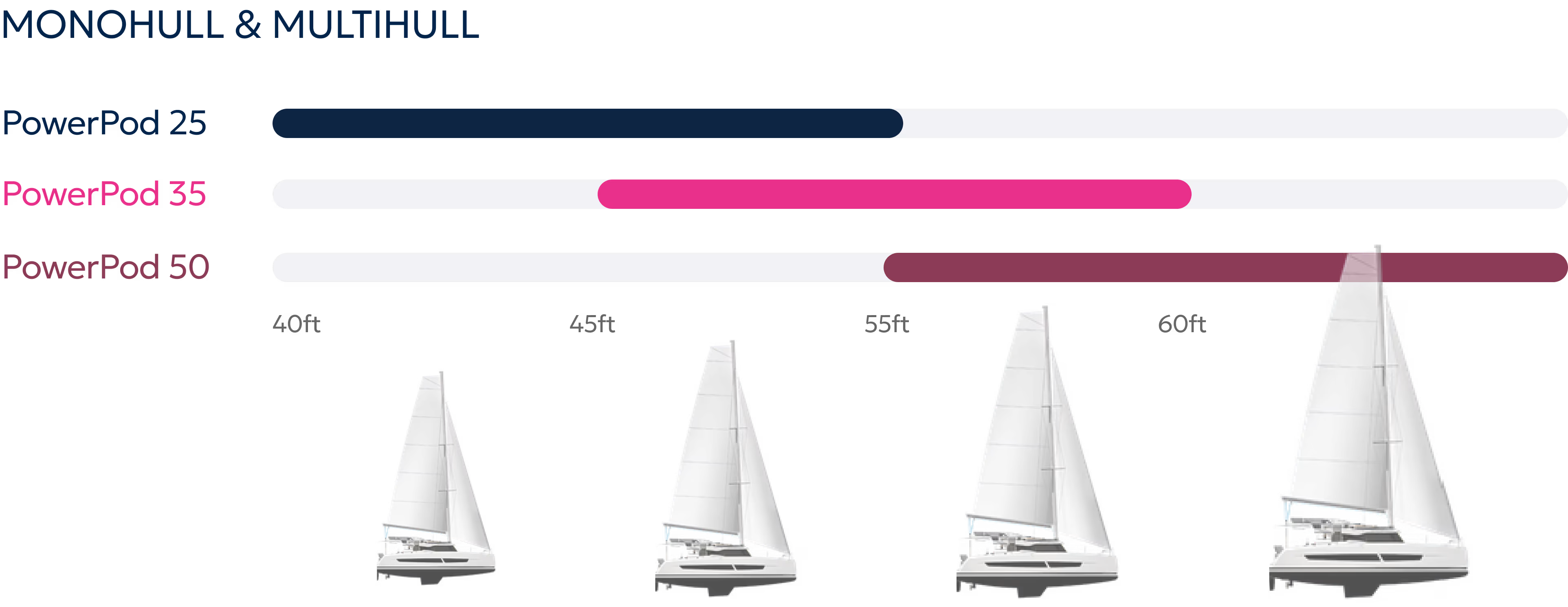
The electric drive pod is available in 25, 35 and 50 kW sized to match hull displacement and intended use. All three share the same direct-drive architecture, natural seawater cooling and 1,100 RPM nominal speed.
| 25 kW | 35 kW | 50 kW | |
|---|---|---|---|
|
Thermal equivalent
|
60 hp | 90 hp | 120 hp |
|
Continuous torque (Nm)
|
250 | 350 | 500 |
|
Nominal speed (RPM)
|
1,100 | 1,100 | 1,100 |
|
Propeller size
|
22–24 inches | 22–24 inches | 24–26 inches |
|
Weight (kg)
|
58 | 58 | 125 |
|
Height × Length (mm)
|
463 × 664 | 463 × 664 | 804 × 786 |
|
Cooling
|
Natural | Natural | Natural |
|
|
|
Full torque, zero RPM
Harbour manoeuvring
Manoeuvring in a marina is where diesel engines are least effective : cold, unresponsive at low RPM, with delayed throttle response. The electric drive pod delivers full torque from zero RPM. Response is immediate and linear, whether holding position at 0.5 knots or applying maximum thrust. No warm-up, no gear selection, no throttle lag.
Silent marina operations
At docking speeds, the dominant sound is water moving past the hull. In marinas, natural areas, and charter zones with noise and emission regulations, silent operation is increasingly a practical requirement, not just a comfort.
Electric propulsion produces no exhaust and almost no mechanical noise, the dominant sound becomes water flow around the hull — barely audible at docking speeds.
Precision handling for catamarans
Twin independent electric drive pods allow differential thrust between port and starboard. The vessel can rotate almost in place, with precise control regardless of wind or current. On a 50-foot catamaran in a tight marina berth, the difference in handling is significant.
For catamaran sailors, the combination of twin independent PowerPods and instant torque creates a level of manoeuvring precision that diesel twin-screw installations cannot match. Differential thrust between port and starboard motors allows the vessel to rotate almost in place, independently of wind, current, or available space. On a 50-foot catamaran in a tight marina box, this is transformative.
Production
Integrated into production lines
JOOOL hybrid-electric systems are integrated into production lines at Fountaine Pajot, Leopard Catamarans, Dufour, Jeanneau, Excess, and Beneteau, among others.
Each system is pre-engineered and factory-tested before delivery. Installation is reduced to mechanical mounting, final wiring, and commissioning, no specialist electrical certification required on-site.
For shipyards building at scale, this standardization means consistent build time and repeatable quality across every hull.
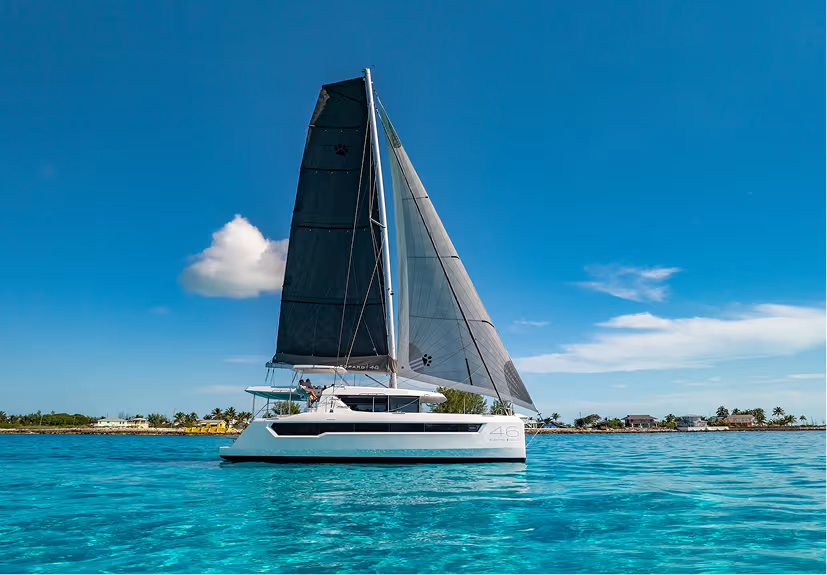
HYBRID LEOPARD 46
Integrated electric propulsion for performance
- 2 × 25 kW PowerPod
- 27 kWh Battery Pack
- 24 kW Genset
Silent electric cruising in harbour, instant torque for tight manoeuvres, hydrogeneration under sail. The JOOOL system is now a factory option across the full Leopard catamaran range.
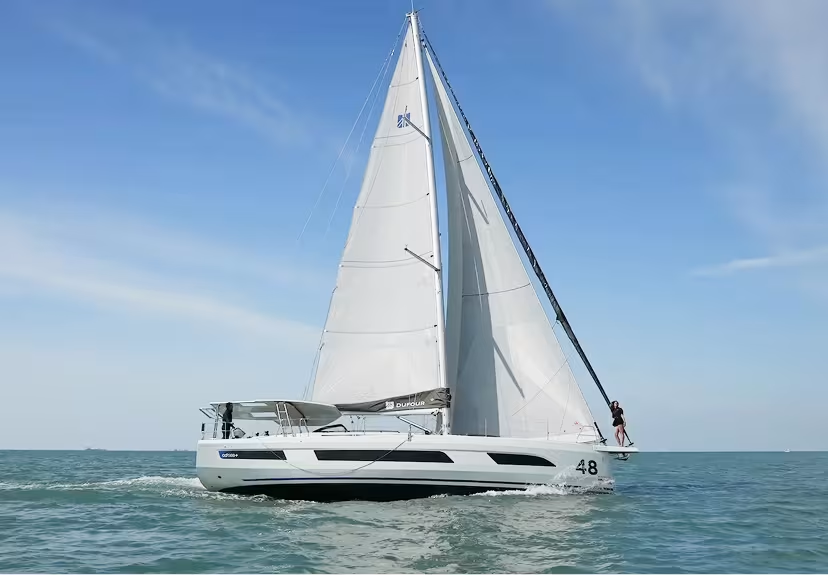
HYBRID DUFOUR 48
Long-range hybrid monohull
- 25 kW PowerPod
- 27 kWh Battery Pack
- 14 kW Genset
Ocean-going monohull with emission-free harbour operation, full recharge via hydrogeneration on coastal passages. Available across the full Dufour range.
MAINTENANCE
What electric propulsion actually requires
Maintenance requirements for electric propulsion and diesel installations compared.
| Maintenance item | Diesel engine | JOOOL PowerPod |
|---|---|---|
|
Oil change
|
Every 100–200h | None - no oil system |
|
Impeller replacement
|
Annual | None - natural cooling |
|
Gearbox service
|
Every 500h | None - no gearbox |
|
Fuel filter
|
Every 200–500h | None |
|
Injector service
|
Every 1,000–2,000h | None |
|
Exhaust system
|
Annual inspection | None - no exhaust |
|
Seal inspection
|
N/A | Every 500h |
|
Anode replacement
|
Annual | Annual (integrated) |
|
Cooling circuit
|
Annual (impeller, HX) | None - seawater cooling |
|
Rated lifespan
|
5,000–8,000h typical | 100,000h+ rated |
For a charter yacht running 500–800 hours per season, the difference in maintenance cost and downtime between a diesel installation and a JOOOL electric system is substantial. Fewer service intervals, fewer parts, fewer engineer visits, fewer days out of service.
Info
Battery pack maintenance: JOOOL Battery Packs are maintenance-free under normal operating conditions. 7-year guarantee at 80% original capacity. After 10 years, individual cells can be replaced at approximately 30% of a full pack replacement cost.
QUESTIONS
Everything you want to know
Direct-drive means the electric motor shaft connects directly to the propeller shaft : no gearbox, no mechanical losses, no vibration transfer. The JOOOL PowerPod is a direct-drive unit: one moving assembly from motor to propeller, with over 93% efficiency and no gearbox to service.
A 38 kWh battery pack at 4–5 knots gives approximately 20–30 nautical miles of pure electric range. However, in practice, hydrogeneration while sailing significantly extends autonomy, recovering 1.5 kWh per hour per PowerPod at hull speed. Most JOOOL-equipped catamarans on Mediterranean itineraries run the generator only a few hours per week.
When sailing with the propeller freewheeling in the water, the PowerPod reverses mode and acts as a generator. The propeller's rotation, driven by the vessel's forward movement : converts kinetic energy into electrical current, which charges the battery bank automatically via the OneBox. No crew action required.
The PowerPod is designed for sailing yachts from 40 to 65 feet, in both monohull and catamaran configurations. Three variants cover the range: 25 kW (~60 hp equivalent) for yachts up to 50 ft, 35 kW (~90 hp) for 45–60 ft, and 50 kW (~120 hp) for 55–65 ft. Catamaran installations use one PowerPod per hull.
Very little. The PowerPod requires seal inspection every 500 hours and annual anode replacement, no oil changes, no impeller, no gearbox service, no exhaust maintenance. It is rated for over 100,000 hours of operation, compared to a typical diesel lifespan of 5,000–8,000 hours.
Yes. With the OneBox Propulsion system, the PowerPod replaces the diesel drive entirely. A generator or renewable sources (solar + hydrogeneration) provide backup charging for extended passages. Many JOOOL-equipped sailing yachts run diesel-free for weeks at a time on typical cruising itineraries.
Ready to electrify your yacht?
Whether you're a shipyard integrating hybrid systems into a production range, or a boat owner looking to upgrade : our team of engineers is ready to help you find the right configuration.
For shipyards & professionals
Integration specs, certification support, commissioning timeline
For boat owners & sailors
System sizing, compatible models, retrofit options