

Silent sailing · Vibration-free · Instant torque
Silent sailing
Electric propulsion eliminates engine noise and vibration from the moment you leave the dock. At sea, under sail, the Electric Drive Pod disappears into the background : no exhaust, no mechanical noise, no interference with the sailing experience. In harbour, instant torque makes manoeuvring precise and predictable, even in tight spaces or strong current.
Comfort
Why conventional yachts are never truly silent
On a conventional sailing yacht, silence is an occasional visitor. Under sail in good wind, you get it, briefly, between tacks, when the engine is off and the sea cooperates. But in harbour, at anchor, in a marina, or motoring in light air, the diesel engine or the generator fills the boat with noise and vibration that becomes background, unavoidable, and exhausting over time.
Most yachts run the generator three to six hours per day for refrigeration, watermaking, air conditioning and battery charging. It runs during meal times, during rest hours, through the night on charter yachts where the crew cannot tolerate the heat without air conditioning.
SILENT MODE
What JOOOL eliminates, and how
The JOOOL Battery Pack : between 21 and 38 kWh per module, scalable to 152 kWh, stores enough energy to power all hotel loads through the night without starting the generator. Refrigeration, lighting, navigation instruments, fans, watermaker, air conditioning for several hours. All from battery storage, in silence.
The generator starts only when the battery drops to a configurable threshold : typically 30%, runs at its optimal efficiency point for a few hours, charges back to 80%, and stops. In practice, on a well-sized system with solar and hydrogeneration input, many JOOOL-equipped yachts in warm-weather sailing grounds run the generator for less than one hour per day. Some days, not at all.
The OneBox Propulsion integrates the electric drive pod as the vessel's primary propulsion. In harbour, the boat motors in silence, no exhaust, no vibration through the hull, no noise on the aft deck. Guests at the stern do not hear or smell the propulsion system. Neighbours in the marina do not hear you leave at dawn. In a busy anchorage where most boats run their generator through the evening, the absence of that noise is an immediate and measurable difference in onboard comfort.
Diesel engines vibrate. The vibration transmits through the engine mounts, through the hull structure, into the sole, the bunks, the countertops. After days at sea, it becomes constant background noise.The electric drive pod has one moving assembly the motor shaft connected directly to the propeller shaft. No gearbox, no alternator belt, no cooling impeller. At 1,000 RPM nominal, it operates far below the resonant frequency range of most hull structures. The vibration signature is, in practice, imperceptible.
Regulations
Silence in restricted and sensitive areas
Beyond personal comfort, silence is increasingly a regulatory and environmental requirement. Marine protected areas, natural reserves, and coastal zones across Europe and beyond are implementing restrictions on diesel engine use : particularly in summer, particularly in anchorages, and particularly in port approach zones.
A JOOOL-equipped yacht with OneBox Propulsion can enter and navigate these zones under pure electric drive, without diesel exhaust or noise. This is not a niche use case, the Calanques de Marseille, the Côte d’Azur natural parks, the Dalmatian coast marine reserves, the marine protected areas of the Canary Islands and the Caribbean, all are moving in this direction. The question for sailors is not whether electric capability will become necessary, but when.

Benefits
Comfort beyond silence: what else changes
Smell
Diesel exhaust has a smell that penetrates every part of a yacht : in the cockpit when motoring downwind, in the engine room after use, in the bilge over time. Electric drive eliminates it entirely. No exhaust, no fuel smell, no residual odour in the accommodation.
01
Heat
Diesel engines and generators produce significant waste heat that raises the temperature of the engine room and, by conduction, the surrounding accommodation spaces. On a catamaran in tropical conditions, this can make the aft cabins uncomfortable during and after motoring. The electric drive pod generates no waste heat, what little it produces is dissipated directly into the water.
02
Night watches
On a passage, the night watch is the quietest time aboard, or it should be. On a conventional yacht, the generator running for battery maintenance, or the engine running in light air, fills the night with mechanical sound. On a JOOOL yacht, the night watch passes in the silence it deserves : wind, water, stars, and the occasional sound of the bow wave.
03
Testimonials
What sailors say
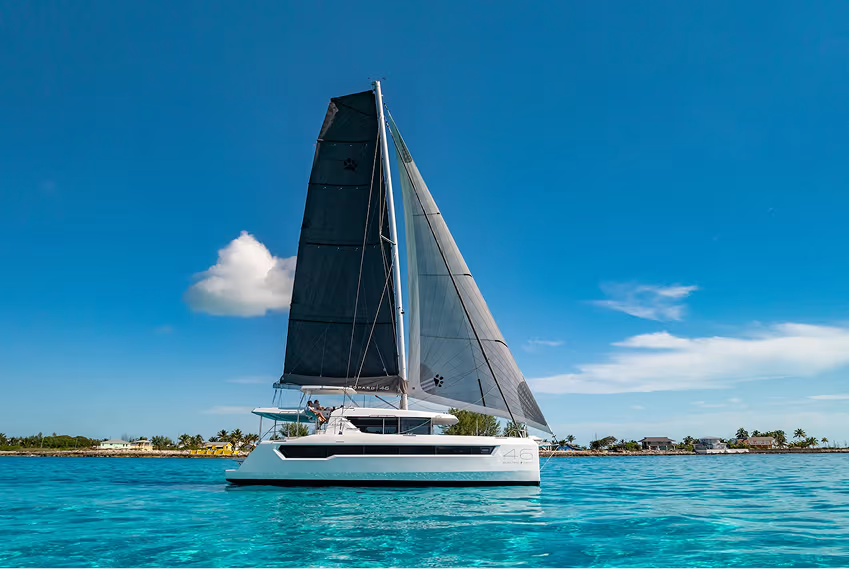
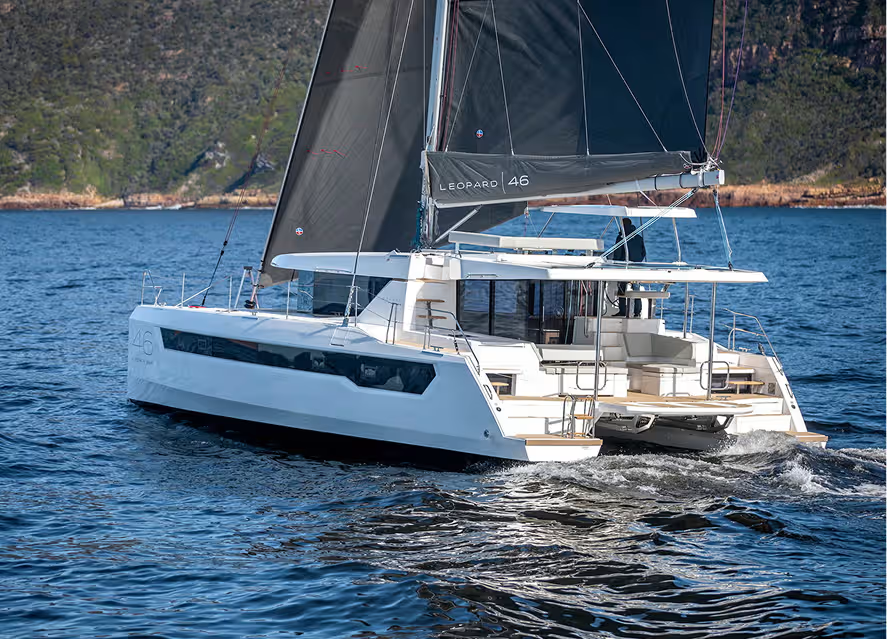
« The first night at anchor, I kept waiting for the generator to start. It never did. I woke up the next morning and it still hadn’t run. That was the moment I understood what this system actually changes. »
Owner, Leopard 46 Hybrid
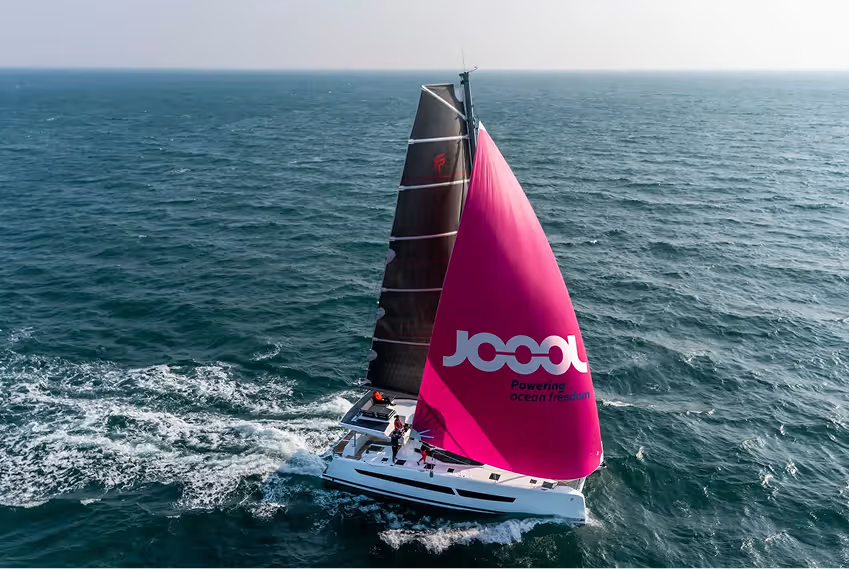
« We charter in the Med. Our guests now specifically ask for a silent boat. It has become a selling point we didn’t expect, silence sells. »
Charter operator, Fountaine
Charter operator, Fountaine Pajot Aura 51 Hybrid
QUESTIONS
Everything you want to know
In practice, yes, for many sailing grounds and use profiles. On a Mediterranean summer itinerary with solar input and regular sailing, many JOOOL-equipped yachts run the generator less than one hour per day, or not at all on good days. Extended offshore passages or high-demand charter use will require more generator time. The system minimises generator use, it does not eliminate it in all conditions.
The PowerPod direct-drive motor produces a very low-frequency hum at operating speed, far quieter than any diesel engine. In practice, crew on deck do not hear the motor. The dominant sound while motoring is the water flowing past the hull.
