

Live aboard anywhere
Home comfort anywhere, without the grid
With up to 152kWh of onboard storage and automated energy management, a JOOOL equipped yacht runs all hotel loads continuously: air conditioning, watermaking, cooking, refrigeration, lighting, without starting the generator. This is what silent mode makes possible: full onboard comfort, in complete silence, for hours at a time.
Autonomy
More autonomy, less generator runtime
Modern yachts are energy-hungry. Air conditioning, induction hobs, watermakers, washing machines, navigation electronics, entertainment systems : the energy profile of a well-equipped cruising yacht is comparable to that of a small apartment. The conventional solution is to run a generator for several hours each day: loud, fuel-consuming and maintenance-intensive. The JOOOL system stores enough energy in the battery bank to cover daily consumption, then replenishes from renewable sources : solar and hydrogeneration, as the voyage progresses. The generator remains part of the system as a range extender, activating only when battery reserves require it and stopping as soon as they are restored.
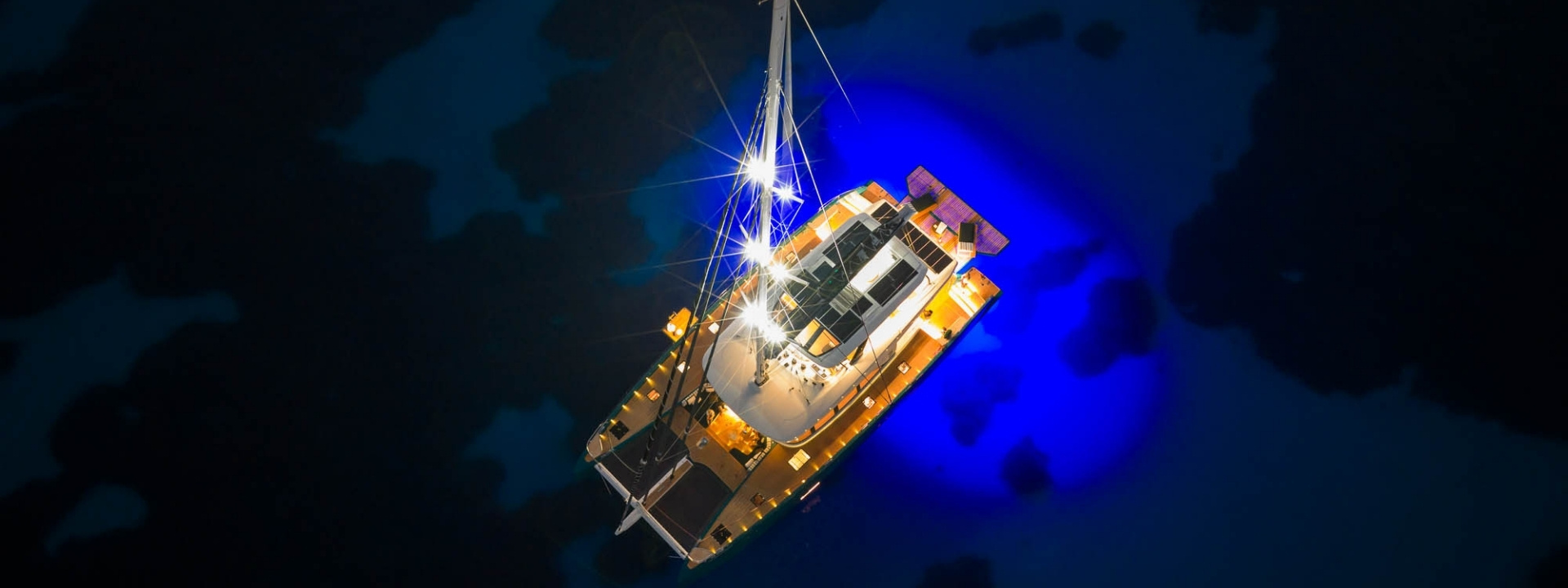
ENERGY
The three energy inputs that change everything
Solar: the silent daytime charger
A well-designed solar installation on a cruising catamaran, typically 800W to 2,000W across the bimini and coachroof, produces 3 to 8 kWh on a sunny day in Mediterranean or Caribbean latitudes. This is enough to cover the baseline hotel load of a modest cruiser through the day, with surplus going into the battery bank for the night. The EPMS manages solar input automatically via MPPT controllers, maximising yield at all times.
For monohulls with more limited deck space, 400W to 800W is more typical, a smaller contribution, but still meaningful when combined with hydrogeneration.
01
Hydrogeneration: recharging while you sail
When the JOOOL system includes OneBox Propulsion, every hour under sail becomes an opportunity to recover energy. At 6–7 knots, each electric drive pod recovers approximately 1.5 kWh per hour. On a twin-engine catamaran, this doubles to approximately 3 kWh per hour, enough to cover a significant portion of the daily hotel load during a good sailing day.
02
Shore power: when available, maximised
When berthed at a marina, the Charger draws AC shore power and charges the battery bank at up to 6.6 kW. The EPMS manages the charging cycle to maximise battery health, never charging to 100% unless a long passage is planned, never allowing deep discharge. The charger is compatible with shore power at any marina worldwide: AC 90 to 265V, 47 to 63 Hz, eliminating the need for adapters in most international ports.
03
Usage
A typical Mediterranean week, the energy arithmetic
Marina departure. Battery at 95% (shore power overnight). Motor out under electric drive, 45 minutes. Sails up. Wind 15 knots, 6.5 knots boat speed. Hydrogeneration running, 3 kWh recovered during 5 hours of sailing. Solar adds 5 kWh during the day. Net consumption after all loads: minus 2 kWh (more recovered than used). Anchor in bay at 18:00. Battery at 97%.
Full day at anchor. No sailing, moderate solar. Daily hotel load: 10 kWh. Solar: 6 kWh. Generator runs once, 1.5 hours: 12 kWh recovered. Battery ends at 88%.
Long passage, 35 nm, 8 hours sailing at 7 knots. Hydrogeneration all day: 24 kWh total (twin pod catamaran). Solar: 7 kWh. Hotel loads: 12 kWh. Net: +19 kWh recovered over consumed. Battery ends at 100%. Generator never started.
Anchorage day, light wind. Solar: 5 kWh. Loads: 11 kWh (AC runs 4 hours for afternoon heat). Generator runs once, 2 hours. Battery ends at 82%.
approximately 3.5 hours over 4 days. Compared to a conventional yacht: 4 to 6 hours per day.
QUESTIONS
Everything you want to know
No. The OneBox and EPMS manages all energy flows automatically. You see one display showing battery level, power flow, and autonomy estimate. The system handles source prioritisation, generator cycling, and load balancing without any crew input.
Yes, for limited periods. A 38 kWh battery bank can power a single air conditioning unit for approximately 6 hours standalone. With solar and hydrogeneration input, this extends significantly. On a catamaran with good solar and regular sailing, it is realistic to run one AC unit through the afternoon and evening without starting the generator on most days.
The EPMS starts the generator automatically when the battery reaches the configured minimum threshold, typically 30%. It runs at optimal load until the battery reaches the target state of charge, then stops. The crew is notified on the display but does not need to intervene.
